
If you run a small business, someone has probably told you that you need AI. Plenty of owners have already started. Estimates of how many run from under one in five in the Census Bureau's business survey to more than three in four among owners in Goldman Sachs' small-business program, because each survey asks a different group a different question. In the Federal Reserve Banks' Small Business Credit Survey, which heard from more than 6,000 small employer firms in late 2025, 46% reported that their business or employees were using AI for work. It's a convenience sample, not a count of every business, but it shows that interest isn't the problem.
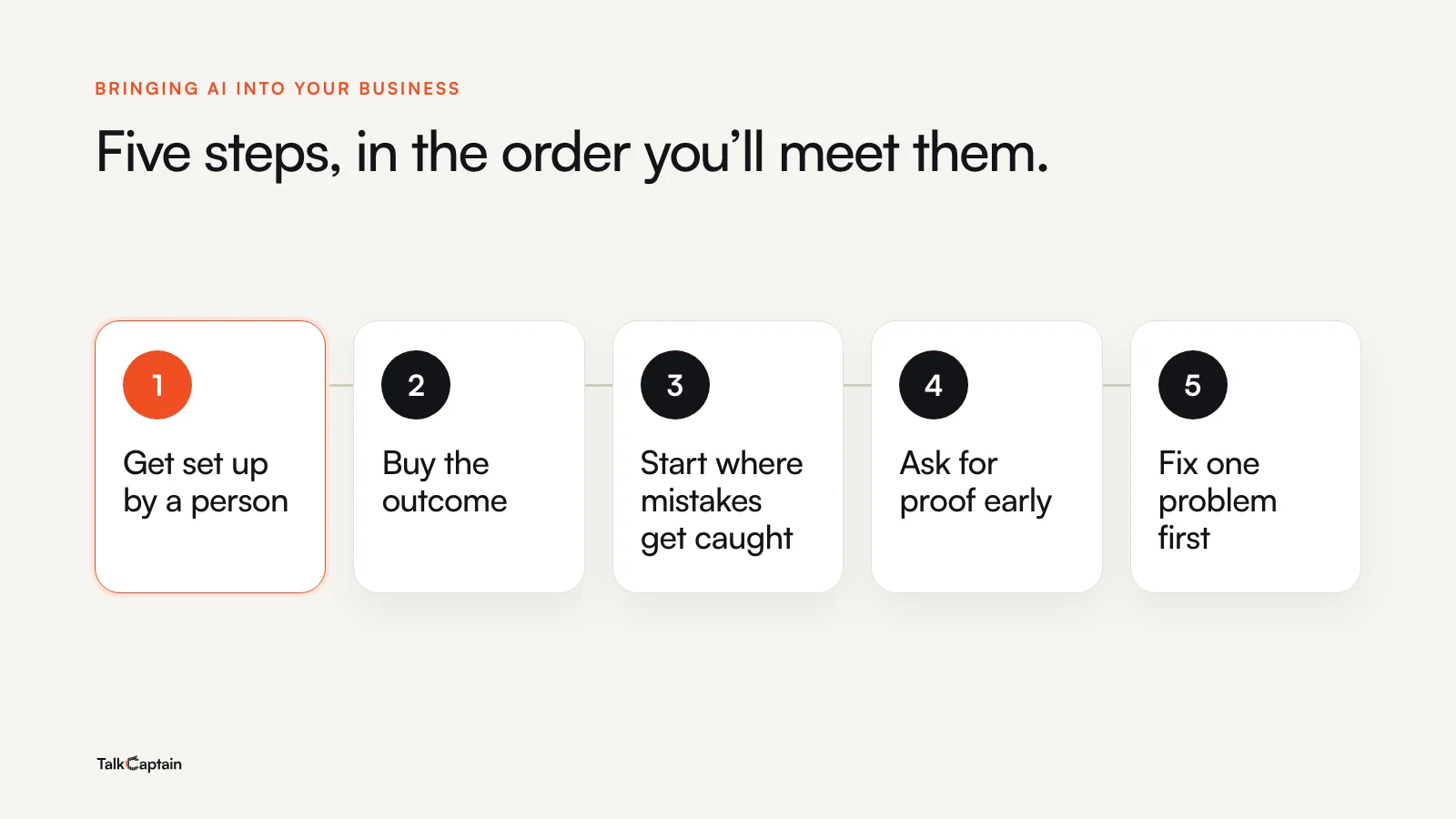
The hard part is turning a tool into something that shows up as booked work. This guide covers what to expect when someone brings AI into your business, and what to ask them for. Here are five steps, in the order you'll meet them. After that come the kinds of business that tend to see value fastest, and what a plan built on these steps looks like.
Step 1: You shouldn't be left alone with a dashboard
A good AI setup is done with you or for you, not handed over as a login. Owners say as much. In a Goldman Sachs 10,000 Small Businesses Voices survey of 1,256 participants in that program, run in early 2026, 73% said they would benefit from additional access to training and implementation resources. In the Federal Reserve survey, firms that plan to use AI named finding tools to meet business needs (54%) and the time required to implement it or train employees (37%) as their top challenges.
A lot of software is sold the other way. A login and a help center hand the setup, and the learning, back to you. So expect a person, not a portal: someone who does the setup with you, stays in touch while it settles in, and picks up when you have a question.
There's a catch. Done-for-you only helps if it gets you running quickly. Weeks of custom work before anything happens is just another way of being left waiting.
What to ask for:
- Who sets it up, and who you call when something isn't right
- How long until it's working, and what they need from you to get there
Step 2: Buy the outcome, not the label
What you're paying for is the result: calls that get answered, inquiries that get a reply the same day, and evenings that aren't spent on admin. The technology is only the means. Judge the offer by what changes in your week, not by the label on it.
Many owners have a fair worry here. They picture a bot that tells a customer something wrong, or a robotic voice that makes a small, personal business sound like a call center. If personal service is why customers choose you, a pitch that opens with AI can sound like a threat to it.
A provider worth hiring talks in outcomes from the first conversation. When you hear a label, ask what it means in practice:
| What you'll hear | What it should mean for you |
|---|---|
| AI receptionist | Calls answered and the caller's details taken, day and night (see what an AI receptionist actually does for you) |
| AI platform | One clear job done well first, not another system to learn |
| AI automation | Repetitive tasks taken off your team, like reminders and follow-ups |
Then test the value against your own numbers. Count last month's calls that went to voicemail or weren't returned the same day. That's your starting number. Take one job you lost to a missed call or a slow reply, and set its value against what a year of the service would cost. For example, a roofer who missed the call for a full roof replacement can do that sum in a minute. Use your numbers, not a sales deck's.
Plain language should carry on after you sign. If the pitch was about results and what you get afterwards is a screen full of AI jargon, ask for reports in your own terms: calls answered, inquiries followed up, jobs booked.
Step 3: Start where a mistake can be caught
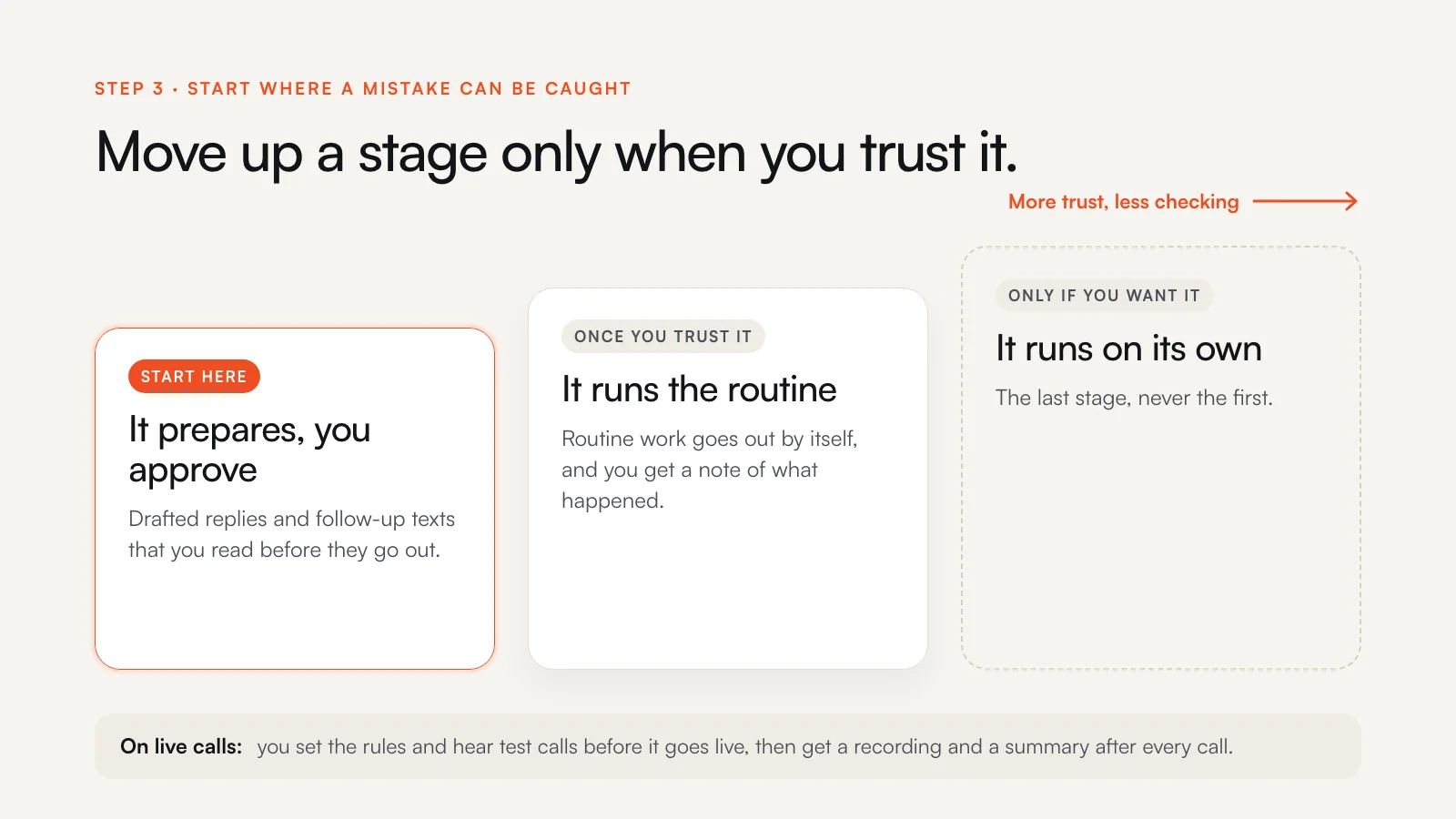
Start with jobs where AI prepares the work and you check it, and move to live, unsupervised work only when you're ready. A drafted reply or follow-up text that you read before it goes out is a safe first job. Live phone conversations and cold calls sit at the other end, because a slip happens in front of the customer and can't be undone.
Accuracy is the right thing to worry about. Firms in the Federal Reserve survey that already use AI named accuracy (46%) and adapting tools to meet business needs (43%) as their top challenges. Your customers have doubts of their own. In a Pew Research Center survey of more than 5,000 U.S. adults in June 2025, 50% said they're more concerned than excited about the increased use of AI in daily life, up from 37% in 2021.
In practice that means three stages. To begin with, the AI prepares and you sign off. Once you trust it, the routine work runs by itself and you get a note of what happened. Running fully on its own comes last, and only if you want it.
Be wary of a pitch that starts at the far end. A lifelike voice agent makes a striking demo, but it's the hardest stage to trust, and it's rarely the right place for your business to begin.
For drafted messages, you can approve each one. For a live phone call you can't, because nobody can approve each sentence while a caller is on the line. On calls, your approval happens at two other points. Before it goes live, you set the rules, say what it must never say and listen to test calls. After each call, you get the recording and a summary. If a provider is going to answer your phone, ask how it's tested before it takes a real call, and compare the answer with what testing an AI agent before go-live should cover.
What to ask for:
- "What reaches my customers without my say-so?"
- Which stage you start at, and what has to happen before you move to the next
Step 4: Ask for proof early
What a service is worth to you depends on whether it will work for your business, so ask to see that before you argue about price. If a quote feels too high, ask yourself whether it's the price or the doubt that it will work. A discount doesn't fix doubt. Proof does.
Firms that already use AI mostly report gains. In the Federal Reserve survey, 71% of AI users said its use led to increased productivity, 39% noted improved quality of goods and services, and 31% reported higher sales. Those are what owners said happened, not measured results, and cost was still a challenge for 21% of them.
Ask what you'll see in the first few days after it goes live, and agree up front what counts as a result. A new dashboard or a kickoff call doesn't count. A note that an after-hours inquiry was answered and passed to you does. On a phone line, the first caught call depends on how many calls come in.
Step 5: Fix one problem first, and plan the next
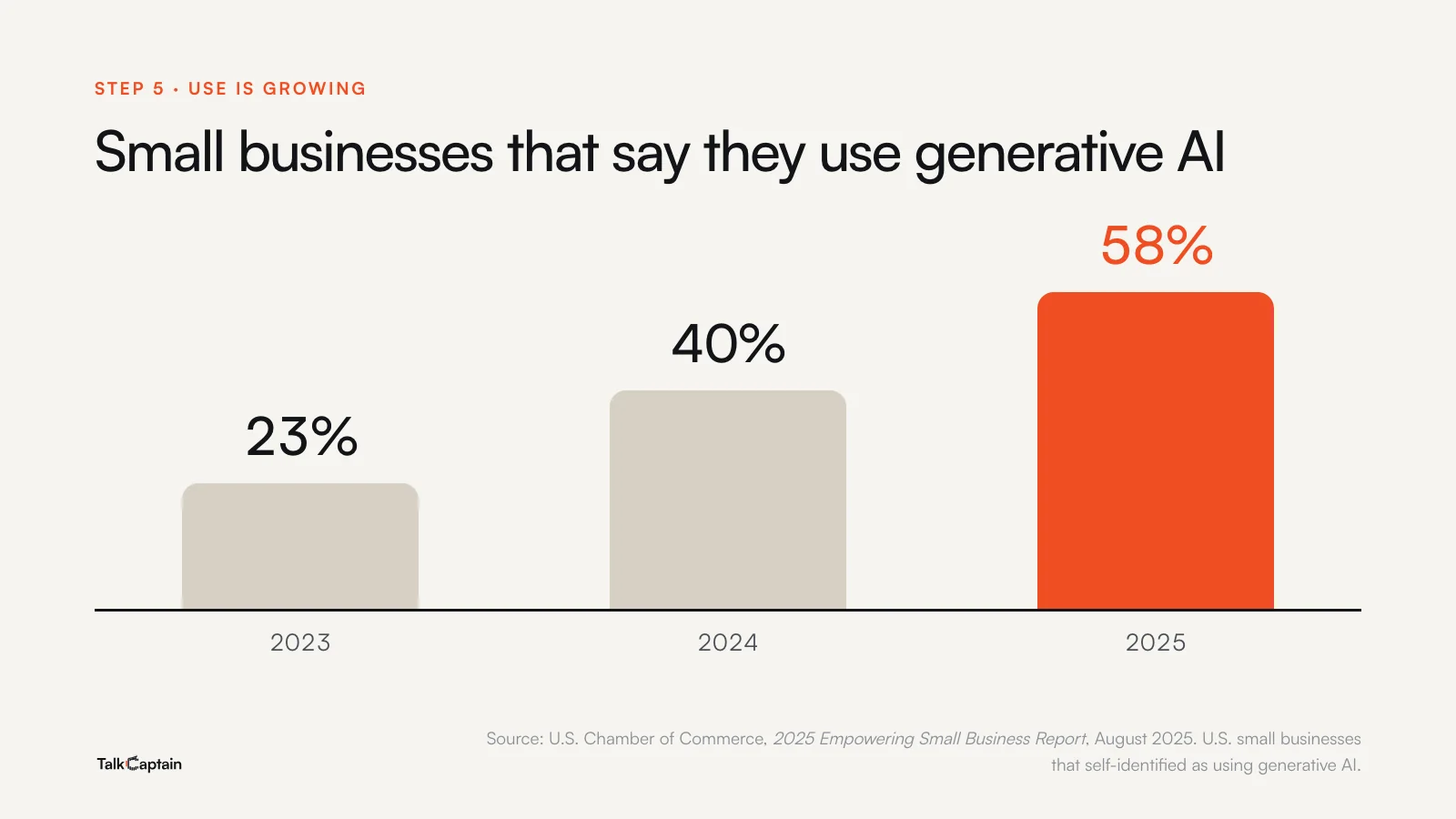
The first thing you buy should fix your most painful problem and leave room for the next one. Use is growing: the U.S. Chamber of Commerce reported in August 2025 that 58% of small businesses self-identified as using generative AI, up from 40% in 2024 and 23% in 2023. The Chamber asked about generative AI and the Federal Reserve about any AI used for work, with different samples, so the two surveys' figures don't compare directly.
Most of that use is still early. In the Federal Reserve survey, about half of the firms using AI said they were experimenting with it, another 44% had partially integrated it into their business processes, and just 7% had fully integrated it. So most businesses are still at the first step, and there's no rush to buy the second.
Start where it hurts most, which for many businesses is missed calls. Agree how you'll count that one problem, and look at the count again after 30 days. If it hasn't moved, fix the setup before you add anything new. Once that works and you trust it, pick the next problem: calling back inquiries, or bookings and reminders. Each next step is easier when the AI connects to the tools you already run, like your calendar and CRM, so ask how that works. Here's how AI agents work inside the software you already use.
Ask for the roadmap up front, so you can see what would come next and the next step is never a surprise sales pitch.
Which businesses get the most value from AI?
The businesses that see value fastest are the ones where the phone brings in the work, and an unanswered call goes to the next number on the list. Plumbers, electricians, HVAC companies and roofers are clear examples: a missed call is often a missed job, so the value is easy to see. Clinics and practices that book by phone are in a similar position.
Whatever your trade, judge it by what changes in your week, not by how quickly you were signed up.
The plan: what this looks like when it's done right
Here's how we put these five steps into an actual plan for a business that runs on its phone. The same plan is also a free, editable template that you can get below.
- Never miss another call. An AI agent answers day and night, takes the job details, books the visit and gets urgent calls to your on-call person. We build it and run it. It answers whenever your phone line is up, so this is the goal we work to, not a guarantee.
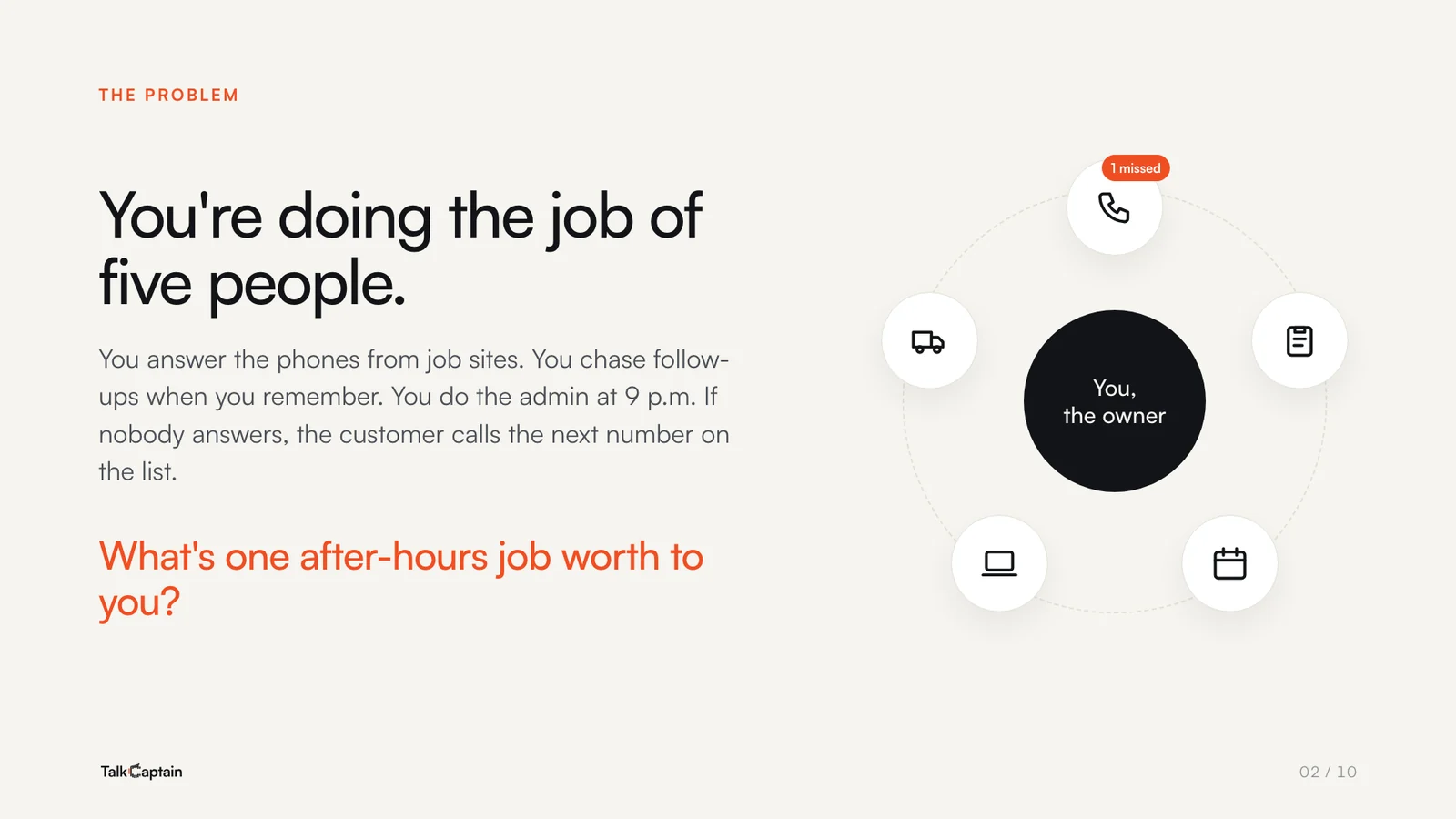
- You're doing the job of five people. One question to start with: what's one after-hours job worth to you?
- An extra set of hands, not another system to learn. Calls answered day and night, urgent jobs sent to you, inquiries called back (only people who asked to be contacted), visits booked, and every conversation recorded, transcribed and summarized. It tells callers it's an AI assistant, and anyone can ask for a person.
- Nothing changes about how you work. What we need from you: a free 30-minute call, your rules, and a listen to the test calls.
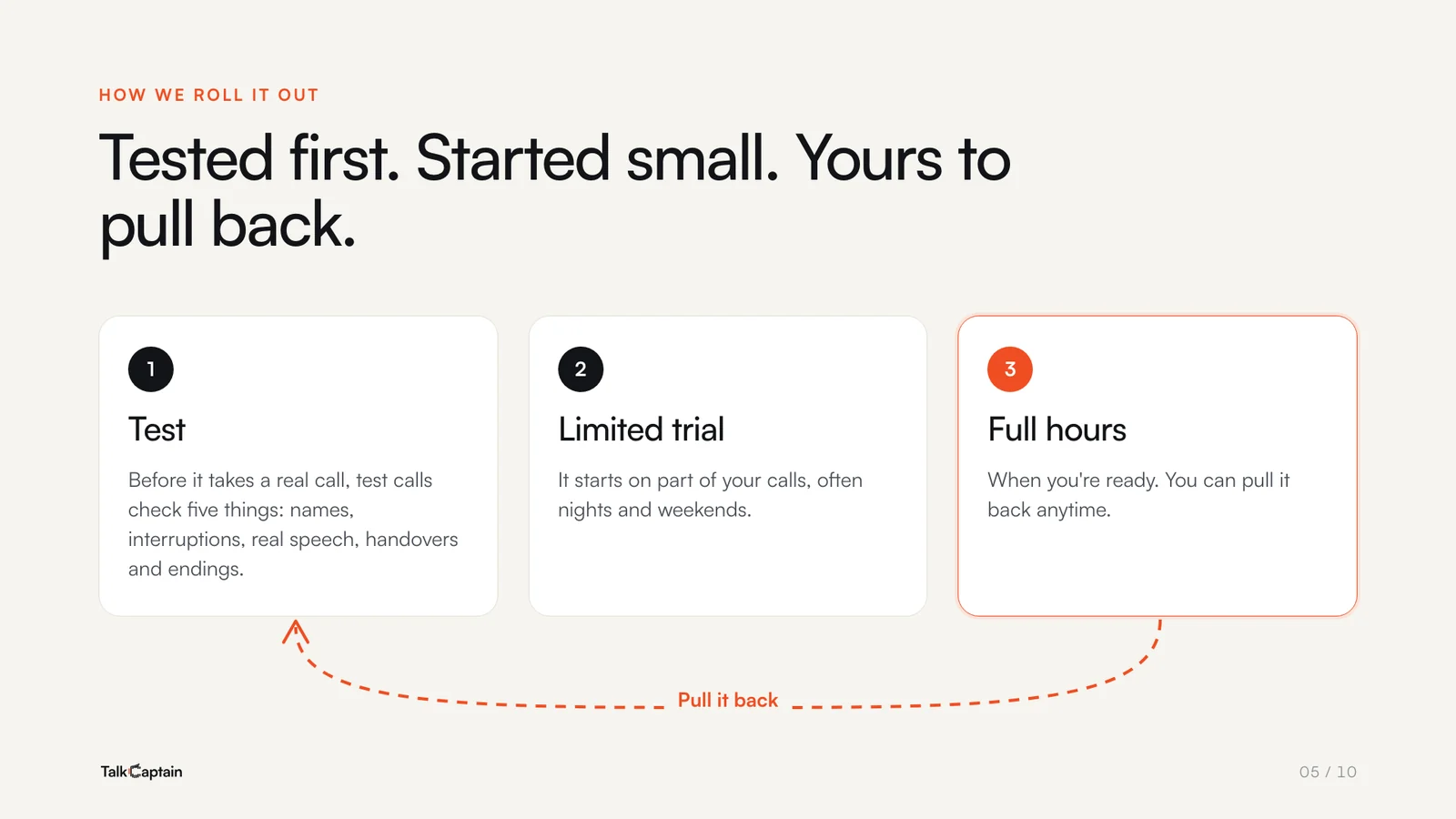
- Tested first. Started small. Yours to pull back. Five checks before it takes a real call (names, interruptions, real speech, handovers and endings), then a limited trial, often nights and weekends, then full hours when you're ready.
- What you'll see in your first weeks. A plan for the conversations, your rules and the tools we connect. Test calls on your rules, before a real one. Every live call as a recording and summary. Then your first real calls, reviewed with you.
- Done for you, not handed a login. We build the whole thing. You tell us how your business works, and we design it, connect it to your tools and test it.
- Start with what hurts most. Stop losing calls first, then call back every inquiry, then bookings and reminders, then your website, too.
- Your plan, on one page. Fill this in before your free call: the calls you miss in a typical week, what one job is worth to you, the hours to cover first, who gets the urgent calls, what counts as urgent, and one thing to check after the first month.
- Book a free 30-minute call. Tell us how your calls and leads work today. Afterwards you get a clear plan, timeline and proposal. Then we build and test it, you sign off, and it starts with a limited trial.
Free template
Never miss another call: the plan
The plan above as slides you can edit and share, plus a one-page plan to fill in before your free call.
10 editable slides
A one-page plan to fill in
If missed calls or slow follow-ups are costing you work, that's the place to start. Book a free 30-minute call and tell us where calls and leads slip through today.
13 Oct 2026: First published.
 Zoe · 6 Oct 2026