

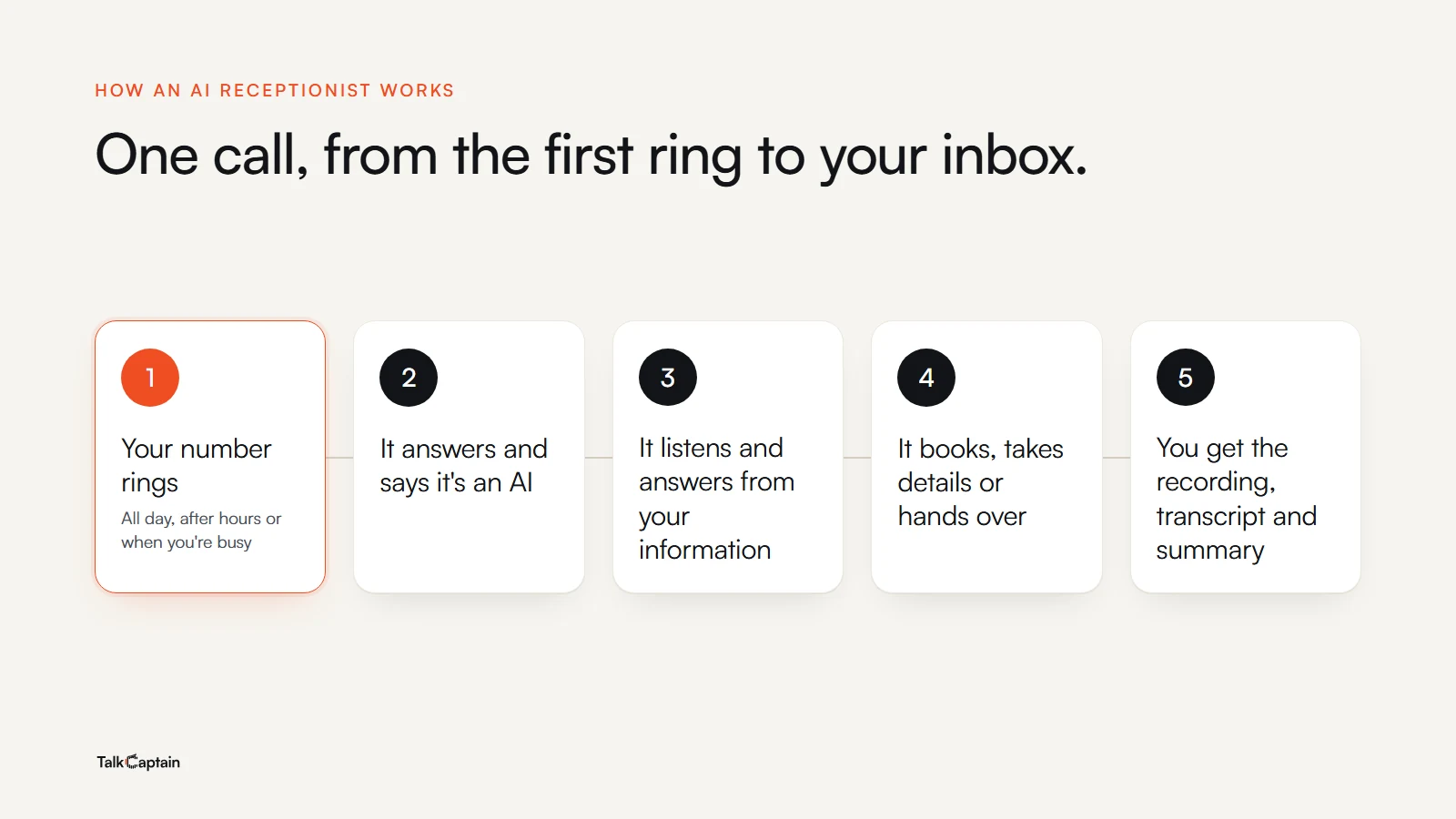
An AI receptionist is software that answers your business phone and talks with callers in ordinary speech. It works out why they're ringing, answers from information you've given it, then books an appointment, takes their details or puts the call through to a person. When the call ends, you get the recording, a transcript and a summary.
Plenty of small firms already use some form of AI. In the Office for National Statistics' report on AI in UK businesses, published on 20 July 2026, 28% of businesses with 0 to 9 employees said they used at least one AI technology, against 49% of those with 250 or more. Answering the phone is a practical place to start, because a missed call is easy to count.
We build AI receptionists at TalkCaptain, so the examples below are ours: sample calls you can play on our calls page, with made-up business details. This guide follows one call from the first ring to your inbox, then answers the questions owners usually ask: does it sound like a robot, what happens when it doesn't know, how it hands over to a person, and what it does with the data.
What happens when someone rings an AI receptionist?
The same thing every time: it picks up, says who it is, finds out what the caller needs, does something about it and tells you what happened. Here's the order, and what you decide at each step before it takes a real call.
| Step | What happens on the call | What you decide beforehand |
|---|---|---|
| 1. The call reaches it | Your number rings through to the AI receptionist, for every call or only when you're closed, busy or don't answer | When it answers: all day, after hours or as overflow |
| 2. It greets the caller | It answers in your business's name and says it's an AI assistant | The greeting, and the name it uses |
| 3. It listens | It turns the caller's words into text, works out what they want and replies in a natural voice | The voice, and the languages it speaks |
| 4. It answers from your information | Opening hours, services, areas you cover, prices you're happy to quote, your policies | What it may say, and what it must never say |
| 5. It does the job | Books into your calendar, takes the details, texts a confirmation or alerts whoever is on call | Which tools it connects to, and what counts as urgent |
| 6. It hands over when it should | Puts the call through to a person, or books a callback with a summary | Who takes which calls, and when |
| 7. You get the record | The recording, transcript and summary, with the key details sent to your CRM or inbox | Where the summaries go |
Our how it works page follows an after-hours clinic call through the same loop: the call comes in at 8:40 pm, Amy (an AI agent) answers, books the appointment, updates the patient log and schedules a reminder, so the front desk sees it on the schedule when they open.
Here's what it sounds like on a short call. In our home-services sample call, Niamh rings a plumber at 11 pm with a burst pipe:
| Time | Speaker | What they say |
|---|---|---|
| 0:00 | Amy (AI agent) | BrightFix Plumbing, this is Amy, the out-of-hours assistant. What's happened? |
| 0:05 | Niamh (caller) | A pipe's burst under the kitchen sink, there's water everywhere! |
| 0:09 | Amy | Please turn off the stopcock under the sink and stay away from wet sockets. Tell me when it's off. |
| 0:14 | Niamh | Hang on. Okay, it's off. It's slowing down. |
| 0:18 | Amy | Well done, that's the hardest part. What is your address, please? |
| 0:22 | Niamh | Twenty-two Willow Lane, Ashford. |
| 0:25 | Amy | Ryan will arrive by 11:45. The call-out is £120 to £180, and he'll text when close. |
Real AI call, pauses shortened. Both voices are AI: the caller is an AI playing a customer. Business details are fictional.
In a 36-second recording, the caller got safety advice, a plumber on the way and a price range, and the business got the job, the address and a text sent to the customer. You can hear the whole call on our home-services page.
Does an AI receptionist sound like a robot?
Not like the robotic phone menus most people picture. It speaks in full sentences in a natural voice, follows the conversation and lets callers interrupt. But it isn't a person, and it shouldn't pretend to be: it should say it's an AI assistant, and answer honestly when a caller asks.
What gives an AI away is usually the detail: a mispronounced surname or street, a pause before a tricky answer, or talking over someone who stops mid-sentence. Those are exactly the things to test before it takes a real call. We check names, interruptions, the way people really talk, handovers and endings on every agent we build; here's how we test an AI agent before it takes real calls.
Callers do ask. In this example call, Callum, who asked about a new kitchen, stops the AI agent two questions in:
| Time | Speaker | What they say |
|---|---|---|
| 0:16 | Callum (caller) | Hang on. Wait a second. Am I talking to a robot? |
| 0:21 | Jack (AI agent) | Good ear. I'm an AI assistant, yes, and a quick one. I handle the first chat, so a real designer turns up knowing exactly what you want. Happy to carry on? |
| 0:31 | Callum | Well, at least you're honest. Go on, then. |
Example call. Both voices are AI. Business details are fictional.
He carried on, and the call ended with a home measure booked. The honest answer is also the practical one: callers who would rather speak to a person can say so, and get one.
What happens when it doesn't know the answer?
It should say so and pass the question on, not guess. A well set-up AI receptionist answers only from the information you've given it. When a question falls outside that, it takes the caller's details and what they asked, then puts them through to a person or books a callback, so someone with the answer rings them back.
You set the edges in advance, in plain words: what it may quote, what it must never promise, and which questions always go to a person. A clinic might let it book appointments and give opening hours, but never discuss test results. A trades business might let it quote the standard call-out charge, but send anything about a complaint straight to the owner.
Safety questions need special care. In our dental example call, Ellie rings at 9 pm with toothache. The AI agent doesn't diagnose. It checks for the warning signs the practice gave it, swelling or a temperature, tells her to call 111 or go to A&E if those appear, then books the first emergency appointment the next morning.
Example call. Both voices are AI. Business details are fictional.
That's the pattern to look for: it follows the practice's rules and books the next step, and the clinical judgement stays with the dentist. Our healthcare page shows how clinics use it for bookings and after-hours calls.
How does an AI receptionist hand a call over to a person?
In one of three ways: it puts the call straight through, it books a callback with a summary, or it alerts someone and carries on. Which one it uses depends on the rules you set and on what your phone system allows.
| How it hands over | When it's used | What your team gets |
|---|---|---|
| Live transfer | The caller asks for a person, it's urgent, or it's a call only your team takes | The caller on the line, with what they've said passed on |
| Callback | Nobody is free, it's out of hours, or your phone system can't transfer the call | The caller's details and a summary, with the callback scheduled |
| Alert | Something needs action but not a conversation now, like an emergency job to send | A text, email or team message with the details |
The best handovers mean the caller never repeats themselves. In our vet example call, Margaret rings because her dog has eaten a bar of dark chocolate. The AI agent takes the dog's size, how much it ate and when, then puts her through to the duty vet nurse:
| Time | Speaker | What they say |
|---|---|---|
| 0:37 | Amy (AI agent) | That's really helpful. I don't want you to wait on this, so I'm putting you through to our duty vet nurse, Jess, right now. I'll pass on everything you've told me, so you won't need to repeat it. |
| 1:02 | Amy | Jess, I have Margaret Price on the line with Biscuit, a seven-kilo Jack Russell who ate a hundred grams of dark chocolate about ten minutes ago. |
Example call. Both voices are AI. Business details are fictional.
Whether a live transfer is possible depends on your phone system. When it isn't, the agent books a callback with a summary instead, so the handover still happens, just not on the same call.
What does an AI receptionist do with your callers' details?
It records the call, writes a transcript and a summary, and sends the details you need to your tools: a booking to your calendar, a lead to your CRM, a note to your inbox. All of that is personal data, so treat the provider as you would anyone handling your customers' information, and get the answers in writing.
In most set-ups your business decides why and how your callers' data is used, which makes you the controller, and the provider is a processor working for you. The Information Commissioner's Office lists what the contract between the two must include: processing only on your documented instructions, security measures, rules for any sub-processors, and what happens to the data when the contract ends.
Before you sign, ask any provider:
- Where are calls processed and stored?
- How long are recordings and transcripts kept, and can you change that?
- Who at the provider can listen to your calls?
- Is your callers' data used to train AI models?
- How do you delete a recording when a caller asks?
- Does it tell callers the call is recorded?
Our own answer to the first question: TalkCaptain's team and agent platform are in India, so callers' data is processed there, and some of our providers are in the United States and other countries. We don't offer UK hosting. Ask us the rest on a call, as you would anyone else.
What do you get after each call?
A recording, a transcript, a summary and the key details, sent to where your team already works. Our agents pull out details like dates, budgets, order numbers and the reason for the call, update your CRM records, bookings or tickets as the call ends, and send a summary to the right person when something needs them. They connect to the tools you already use through those tools' APIs or n8n.
The summaries are also how you check it's working. Read a handful every day in the first weeks, and you'll spot a wrong answer or a clumsy handover long before a customer complains.
What can't an AI receptionist do well?
Anything that needs judgement, negotiation or a relationship. It's good at the first conversation: answering, sorting, booking and taking details. People are better with complaints, bad news, haggling over a quote and callers who are upset, and a good set-up passes those on early.
Two more limits. It only knows what you've told it, so out-of-date prices or opening hours become wrong answers until you update them. And a bad line or a noisy van makes any listener, human or AI, ask the caller to repeat themselves.
How do you start using an AI receptionist?
Most businesses keep their number and divert calls to the AI receptionist, starting with the hours when nobody can answer. A sensible start looks like this:
- Choose the calls. After hours, overflow when you're busy, or every call.
- Write the rules. What it can say and book, what counts as urgent, and who takes handovers.
- Hear test calls on your own awkward scenarios before a real caller does.
- Go live for a limited trial, often nights and weekends, and read the summaries.
- Widen the hours once you trust what you hear.
Some services you set up yourself; others, including ours, are built for you. Our UK buyer's guide to AI receptionists compares the options, with the prices each one publishes. To see what ours does, read about our AI receptionist and how it works for UK businesses, or hear our agents on real and example calls.
How we made this: Jack, our AI agent, drafted this article from our brief and the sources linked above, and Vivek checked every claim before it went live.
24 Oct 2026: First published.
 Zoe · 24 Oct 2026